One of the most important characteristics when comparing acceleration sensors is the frequency response range that each acceleration sensor is capable of measuring accurately.
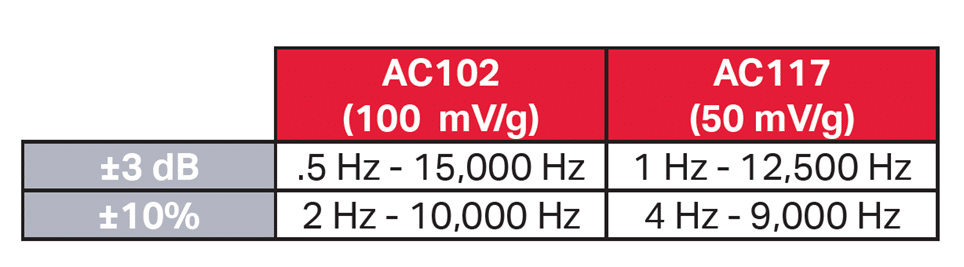
The graph above shows the amplitude responses of two different sensors over the given frequency ranges. Within these ranges, the amplitude response is sufficient for conventional condition monitoring. Typically, the measurement range of a less sensitive sensor is narrower.
More specifically, the AC102 (100 mV/g) acceleration sensor enables the detection of frequencies between 0.5 Hz – 1 Hz and 12 500 Hz – 15 000 Hz within a ±3 dB tolerance, which is not possible with the AC117 (50 mV/g) acceleration sensor.
The next feature we are going to examine is the dynamic range of the accelerometer. Dynamic range essentially means how strong a vibration the particular sensor is capable of detecting.
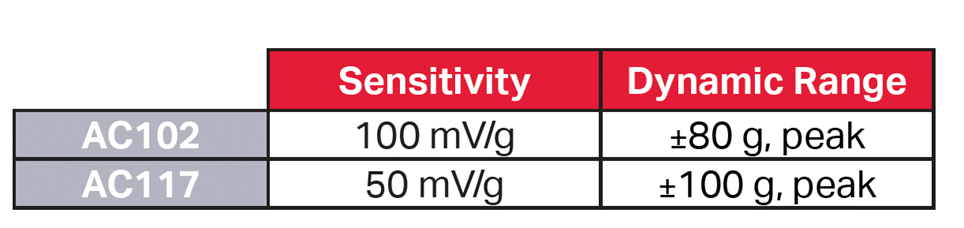
The wide voltage range of modern analyzers ensures that the signal does not clip even at high g values.
The final difference between the two sensor technologies is spectral noise. This characteristic only affects the sensor signal at extremely low velocities. In a real-world environment, the user is unlikely to ever encounter problems from the spectral noise of 100 mV/g or 50 mV/g accelerometers. For comparison purposes, however, we will look at the differences.
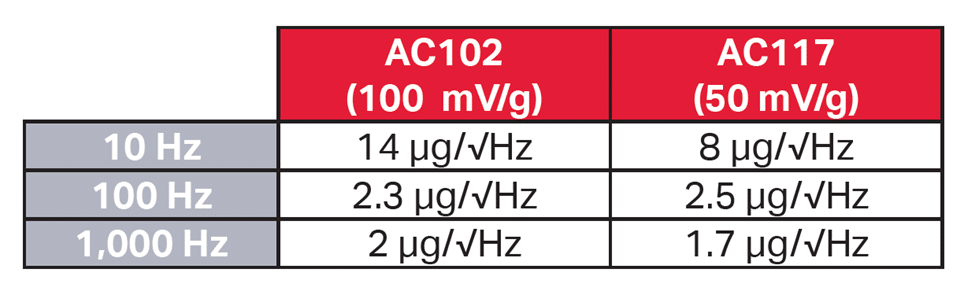
In summary, CTC’s modern 100 mV/g acceleration sensor with a ±80 g dynamic range is, thanks to its characteristics, suitable as a general-purpose sensor for the majority of measurements, which is why it is also the most common choice among our customers.