
Vibration Analysis and Condition Monitoring

What Does Vibration Measurement Mean?

Vibration measurement is one of the most important and effective tools in industrial condition monitoring. It is based on the fact that every rotating machine has its own characteristic vibration profile. As the condition of a machine deteriorates, its vibration changes in a way that can be detected and analyzed long before the damage becomes visible or causes machine failure.

In vibration measurement, the mechanical movement of a machine is monitored using sensitive sensors (typically accelerometers). The measurement data is converted into an electrical signal, which is analyzed using specialized software.

Vibration measurement can be performed using various techniques:

Time domain analysis
Frequency analysis (FFT)
Phase angle measurement
Trend monitoring (overall values)
Standards-based classification and interpretation (according to ISO standards)
Frequency band- and parameter-based analysis

Among these techniques, a suitable solution can be found for different situations.

What Are the Benefits of Vibration Measurement for Your Company?

The primary goal of vibration measurement is to move from reactive maintenance (repairing equipment when it breaks down or when maintenance needs can be heard) to condition-based maintenance (servicing equipment only when it is actually needed).

Vibration analysis can identify the most common mechanical problems weeks or even months before a catastrophic failure:

Bearing damage: Different types of bearing defects appear in the vibration spectrum at a very early stage—often several months before they can be detected by ear.

Imbalance: For example, dirt accumulated on fan blades or material loss causes vibration that unnecessarily stresses the bearings.

Misalignment: Misalignment between coupled machines (e.g., a motor and a pump).

Mechanical looseness: Loose mounting bolts or worn fits.

The overall purpose is to reduce maintenance costs while at the same time increasing the time available for actual production.

How Is Vibration Measurement Performed?

When vibration measurement is introduced as part of maintenance and condition monitoring begins, the appropriate methods must be selected. There are several different methods for performing vibration measurement:
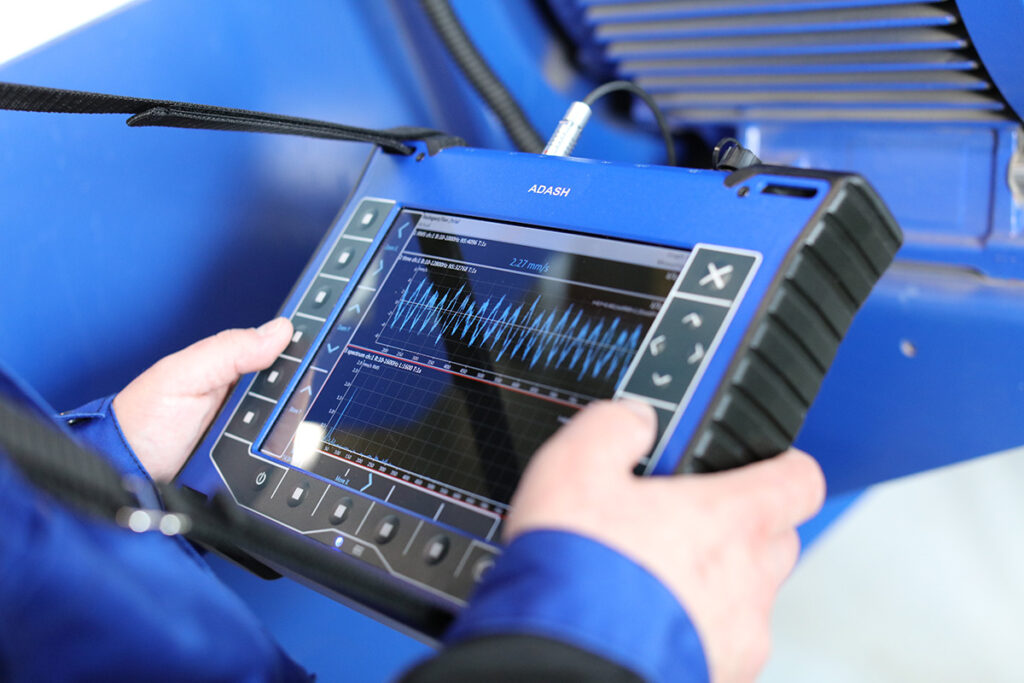
Route-based measurement: Our specialists inspect equipment using portable measuring instruments. This is a cost-effective way to get started and to cover a large equipment base. After completing the measurement route, the data collected from each machine is analyzed thoroughly to identify potential faults. Following the analysis, the customer receives a report with recommended corrective actions. The greatest benefit from route-based measurement is achieved when it is performed regularly, for example 4–6 times per year.

Wireless sensors (IoT): Easy and quick to install at the measurement location. There are various wireless sensor solutions available on the market, some of which include analysis services while others do not. In our installations, we use CTC wireless sensors, which do not require customers to commit to cloud services—they can keep all their data in-house. If required, we also carry out the configuration and installation work related to data collection. A wireless sensor alone is not yet a complete solution if more than overall vibration levels are required. More detailed analysis requires evaluation by a qualified professional.

Permanent online monitoring: Suitable for continuous measurement in applications where, for example, high rotational speeds can cause developing faults to become catastrophic very quickly. In permanent online monitoring, sensors are installed on equipment using cables. These cables are typically connected to the plant automation system, where overall vibration levels can be monitored in real time. Sensors are available that transmit a 4–20 mA signal directly (e.g., LP204), or dynamic accelerometers (e.g., AC192) can be used together with a signal conditioner (e.g., SC150). The advantage of the latter option is the ability to record more detailed signal data when a fault condition occurs.


Benefits of Vibration Measurement

The cost savings provided by vibration measurement come mainly from three sources:

Avoided production losses: Every unplanned production shutdown results in additional costs. Generally speaking, preventing a single production stoppage has saved more money than years of condition monitoring through vibration measurements.

Lower repair costs: When a machine fails, it often causes additional damage and increases the need for fault investigation. On the other hand, fully functional machines do not necessarily need excessive maintenance. Knowledge is power, and vibration measurements tell you when equipment actually requires maintenance and which components are worn.

Improved occupational safety: When factory production stops unexpectedly, work becomes more urgent, and as a result, the risk of accidents has been proven to increase.

Time to Start Vibration Measurement?

If your company has not yet implemented vibration measurement as part of its maintenance strategy, we recommend contacting our sales team and telling us more about your needs. We will prepare a proposal for getting started, tailored specifically to your requirements.

We offer a wide range of measurement services and use industry-leading equipment together with certified experts for measurements and analysis. We have served as an independent expert in the field for more than 20 years. Our experience enables us to provide objective and reliable assessments of equipment condition without any commitments to spare parts manufacturers.

Get in touch and let’s begin our collaboration

We listen carefully to our customers and ensure that our solutions meet their real needs through deep industrial expertise.

We execute projects flexibly, either partially or fully, always tailored to the customer’s requirements.

Collaboration and customer-focused design are at the core of our operations, and we provide ongoing support and development even after project completion.