Acceleration sensor mounting has a direct effect on its frequency response. However, there are situations where the optimal mounting method is not possible, so alternative methods must be used. In general, it can be said that the larger the contact area between the sensor and the machine surface, the more accurate the measurement is at high frequencies. Direct mounting with a screw or epoxy usually makes it possible to utilize the sensor’s frequency response in its entirety. This method provides better contact between the sensor and the machine surface. In contrast, when using, for example, a contact tip, the contact area remains very small, which also has a significant effect on the usable frequency response.
Mounting with a screw
Each acceleration sensor comes with a mounting screw or bolt that has been used to calibrate the sensor. The mounting screw is naturally the recommended mounting method, and it allows the sensor’s technical characteristics to be fully utilized. A mounting screw is suitable for permanent installations, but for a route-based measurement technician, it is often not practical to screw the sensor into a threaded hole for every measurement. However, if you need measurements at frequencies above 10 kHz, the mounting screw is the best way to achieve a reliable measurement result.
Mounting with adhesive
If a threaded hole cannot be drilled into the machine, the next best option after a mounting screw is adhesive mounting. The method is also well suited for temporary monitoring of a machine. A high-quality, correctly sized mounting plate, such as MH130-1A, and a properly selected adhesive enable very high-frequency measurements. The location of the adhesive pad should be selected on as flat a surface as possible, and cleaning the surface is of utmost importance. For the adhesive, we recommend, for example, MH109-2A Devcon Plastic Welder.
Mounting with a quick connector
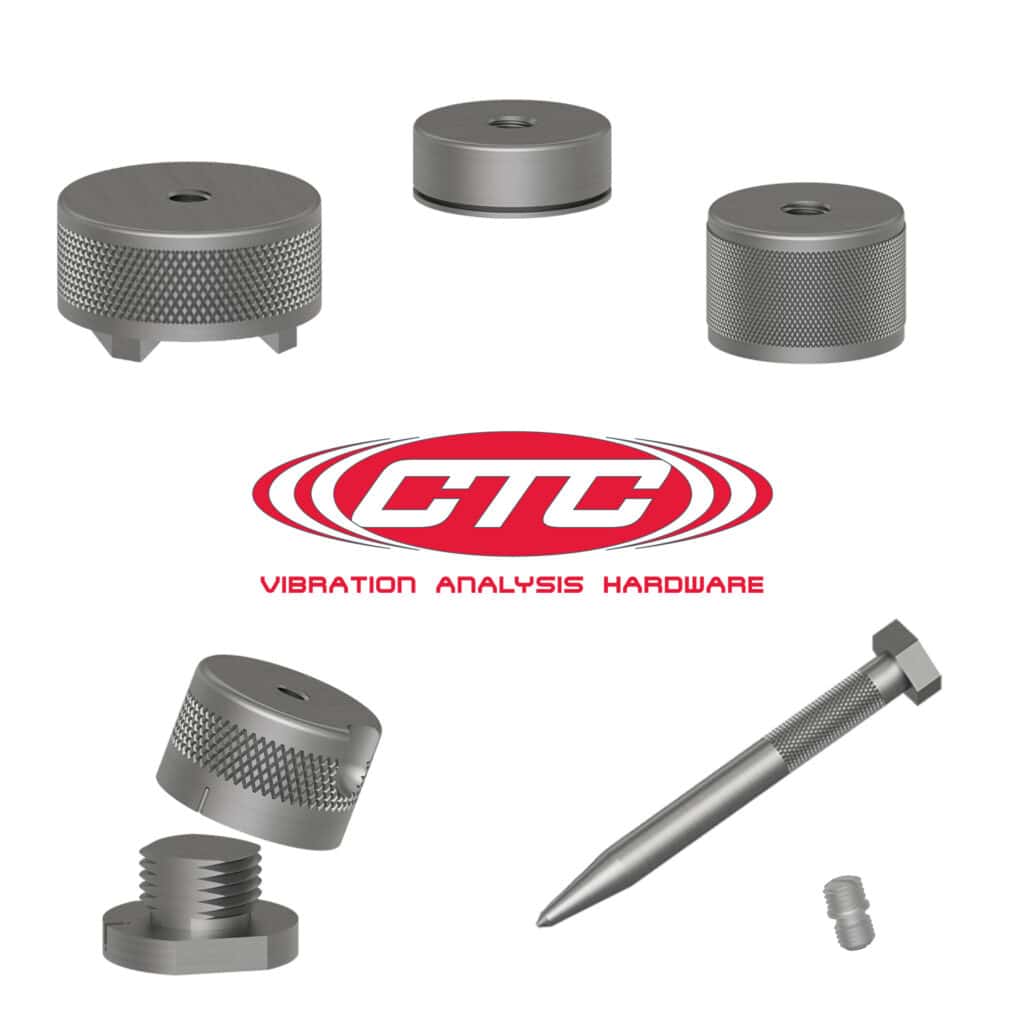
A quick connector, e.g. MH107-1B + MH107-1A, enables better sensor attachment to a surface than a magnet designed for curved surfaces. The use of quick-mounting plates is sensible if route-based measurements include locations where high-frequency measurements are required regularly. These keep the mounting point more consistent, whereas the position of a magnet always changes slightly between different measurements. The frequency response of quick-mounting plates is slightly higher than that of a curved-surface magnet due to the larger contact area with the sensor.
Magnetic mounting
Magnets are commonly used for temporary mounting, for example in route-based measurements. Magnetic mounting, however, limits high-frequency measurements, as the small contact area filters out high frequencies from the measurements. With a magnet, it is nevertheless possible to obtain sufficiently high frequencies to detect most faults, such as bearing damage. When using a magnet, it is also important to take into account the additional mass introduced by the magnet, which creates a new, lower resonance frequency and a change in the frequency range. On flat surfaces, it is always advisable to use a flat-surface magnet, such as MH122-1A, so that the contact area is as extensive as possible. Curved surfaces have their own magnet with two feet, e.g. MH114-3A.
Contact tip
A contact tip, such as MH119-2A, makes it possible to measure vibration in difficult locations, such as between the laminations of a motor. However, a contact tip cannot reliably measure frequencies below 10 Hz, as displacement of the machine makes it difficult to keep the tip completely stationary. Frequencies above 500 Hz may also be distorted. Measurement with a contact tip is the least reliable sensor mounting method, but it is a usable method if there is no other option for the measurement.
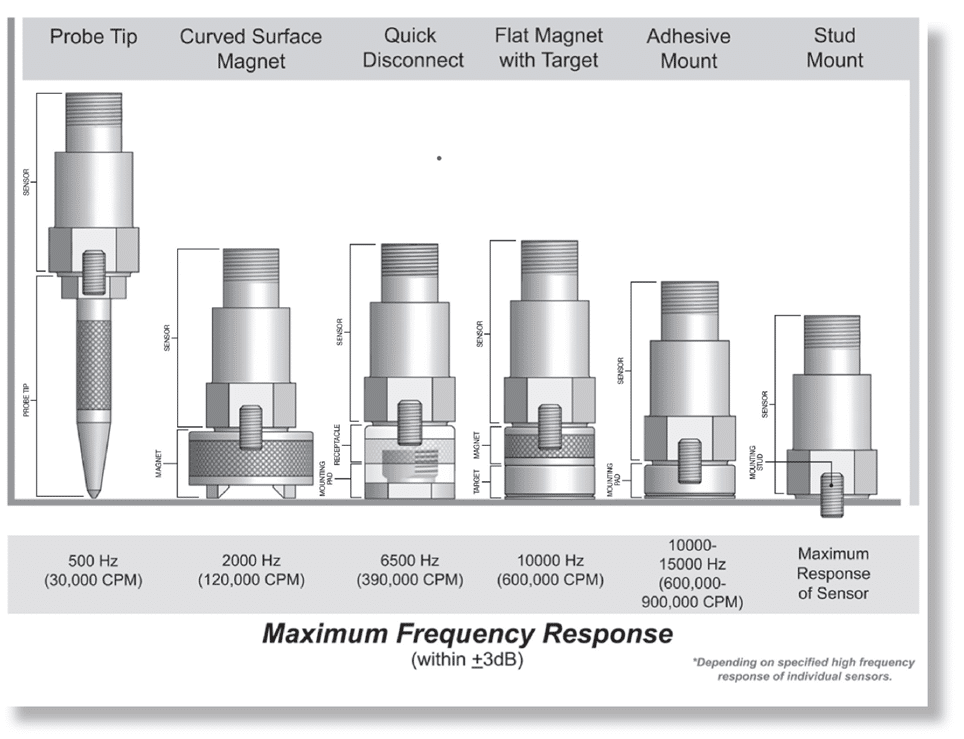
Figure 1. Different mounting methods and the recommended maximum frequency response for analysis.
There are therefore several mounting methods, and each has its own purpose. Low-frequency vibrations can be measured confidently using all of the techniques mentioned below. In these cases, the limiting factor is the technical characteristics of the sensor itself, not the sensor mounting method. For high-frequency measurements, the technician must consider more carefully how the sensor is mounted.