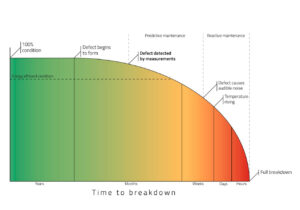
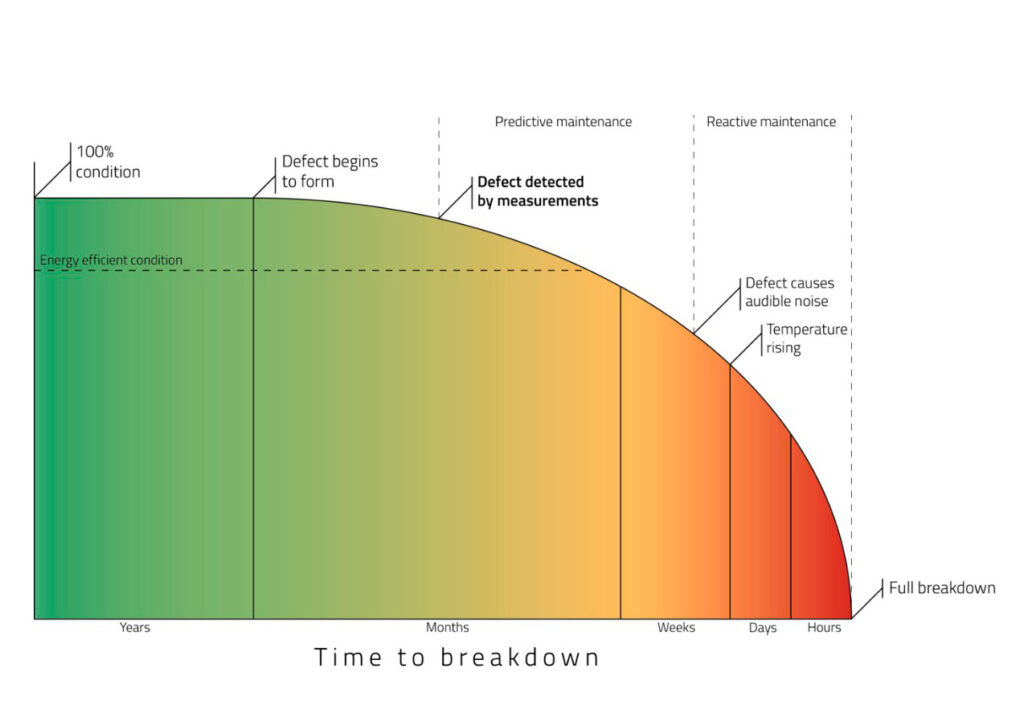
Predictive maintenance helps prevent common equipment failures. Equipment breakdowns and production stoppages often come as a surprise. However, most equipment failures show signs of developing faults weeks or even months before the actual breakdown occurs. The problem is often that these signs are not detected or interpreted correctly.
In predictive maintenance, the condition of machinery is continuously monitored. This makes it possible to identify developing faults before they cause costly production downtime. By using the right condition monitoring methods, equipment lifespan can be extended, safety improved, and overall maintenance costs reduced.
Below, we have compiled the five most common equipment failures that could most often have been prevented through predictive maintenance.
1. Bearing Failures
Bearings are one of the most common failure points in industry. They naturally wear over time, but inadequate lubrication, contamination, misalignment, or overloading significantly accelerate wear. Up to 80% of all bearing failures are caused by lubrication problems or contamination.
Typical symptoms include increasing vibration, abnormal noise, rising temperature, and changes in the lubricating oil.
The good news is that bearing faults can be detected at a very early stage through regular vibration measurements, thermal imaging, or oil analysis. In many cases, the first signs appear long before operators notice anything unusual.
2. Imbalance in Rotating Machinery
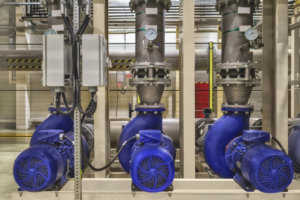
Fans, pumps, motors, and other rotating machines often suffer from imbalance. The rotating force created by an imbalance places stress on the structure, gradually damaging it. This increases vibration and heat, accelerates bearing wear, and shortens the service life of the entire machine. Even a minor imbalance in rotating machinery reduces energy efficiency and can lead to costly damage.
Imbalance may be caused by wear, contamination, damaged blades, manufacturing defects, or installation errors.
Vibration measurements are a highly reliable method for detecting imbalance. When the issue is identified early through condition monitoring, field balancing can be carried out in a controlled manner on-site during a planned maintenance shutdown, without unexpected production interruptions.
3. Misalignment
Shaft misalignment is one of the most underestimated causes of equipment failures. In industry, it often leads directly to increased energy consumption, production downtime, and spare parts costs. For example, the problem may arise after maintenance if the equipment is not realigned with sufficient accuracy.
Even a small alignment error can cause severe vibration, bearing damage, shaft seal failures, and unnecessary energy consumption.
Identifying misalignment early can result in significant cost savings. Predictive maintenance based on vibration measurements reveals misalignment before it causes serious problems.
4. Lubrication Problems
Insufficient, excessive, or incorrect lubrication is one of the most common causes of premature machine failure. Monitoring lubricant condition and performing regular condition monitoring help identify lubrication problems early. At the same time, metal particles or contaminants indicating the onset of wear can also be detected.
The consequences of lubrication problems include increased friction, rising temperatures, rapid bearing wear, and higher energy consumption.
5. Early Motor Faults
Electric motors are the heart of almost every production facility. In most cases, a motor does not fail suddenly; instead, its condition gradually deteriorates. The most common signs of motor faults include overheating, increased vibration, and unusual noises.
Motor failures may be caused by bearing damage, imbalance, electrical faults, overloading, or cooling problems.
Vibration measurements, temperature monitoring, and other condition monitoring methods make it possible to identify faults well before production is interrupted.
Why Is Predictive Maintenance Worthwhile?
In many companies, maintenance is still based on the philosophy of “repair it when it breaks” or on fixed maintenance schedules. Reactive maintenance is often the most expensive option, and servicing equipment that is still in good condition also generates significant costs. In some cases, unnecessary maintenance can even increase the risk of equipment failure due to installation or alignment errors. The goal of predictive maintenance is not to increase maintenance activities, but to perform the right maintenance actions at the right time.
A single unexpected equipment failure can result in:
- Production downtime
- Urgent spare parts purchases
- Overtime work
- Delivery delays
- Safety risks
Condition monitoring makes it possible to schedule maintenance according to actual equipment condition, reducing unnecessary maintenance shutdowns, lowering overall costs, and improving safety.
Condition Monitoring Provides Data to Support Decision-Making
Modern predictive maintenance utilizes a variety of measurement methods. When the actual condition of machinery is known, maintenance becomes planned rather than reactive. At the same time, production availability improves and the service life of investments is extended.
Predictive maintenance methods include:
- Vibration measurements
- Temperature monitoring
- Oil analysis
- Ultrasound measurements
- AI-based anomaly detection using measurement and process data
When a company utilizes predictive maintenance and modern condition monitoring methods, it can:
- Reduce unplanned production downtime
- Lower maintenance costs
- Improve workplace safety
- Extend machine service life
- Increase production reliability
Predictive maintenance is not merely a cost—it is an investment in production continuity and competitiveness. With the support of an experienced partner, a company can build a condition monitoring solution tailored to its specific production environment and identify developing faults before they become costly equipment failures.