
Description
Features
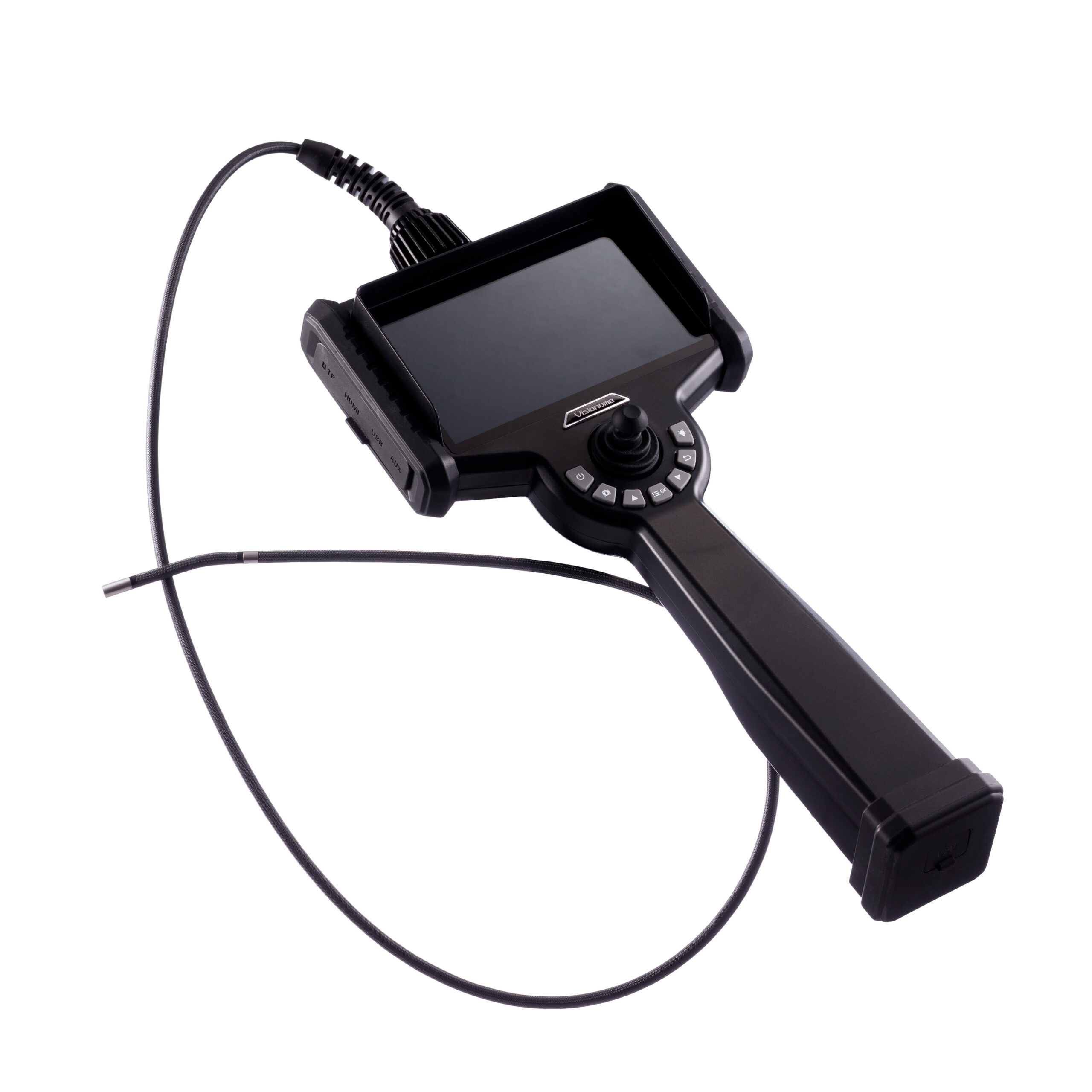
TheFlexLumen B series ofindustrial endoscopes with a swivelling head brings a whole new level of versatility and performance to endoscopes. In addition to white light, UV (365 nm) or infrared (IR) light is available.
Industrial endoscope with swivelling head
The FlexLumen B series brings a whole new level of versatility and performance to endoscopes. The advanced fibre-optic light source produces light up to 3–4 times brighter than standard LEDlighting, which, combined with exceptionally small cable diameters, makes it an unbeatable tool for industrial maintenance and demanding quality control. The FlexLumen B Plus range takes usability to a new level by enabling simultaneous viewing of forward-facing and side-view images on a new 6-inch touchscreen. This eliminates the need to change lenses mid-inspection, saves time and provides a comprehensive overview at a glance.
Features
Display: New 6-inch IPS high-resolution touchscreen (1920×1080) – allows image adjustments (contrast, brightness, white balance) and reference measurements to be carried out directly on the device. Cable diameters: The widest range on the market: 0.95 mm, 1.2 mm, 1.8 mm, 2.4 mm, 2.8 mm, 3.9 mm and 6.0 mm. Manoeuvrability: 2.4 mm – 6.0 mm: Full 360-degree mechanical rotation (all-way steering). 1.8 mm: 2-way rotation. 0.95 mm – 1.2 mm: Fixed (non-steerable). Light source: High-performance fibre-optic illumination. In addition to white light, UV (365 nm) or infrared (IR) light is available. Material: Multi-layered tungsten braiding (tungsten) effectively protects the cable from wear and damage. Protection rating: Cable IP67 (0.95–1.2 mm models IP54) Storage: JPEG photos and MP4 video recording to a 32 GB micro-SD card (supports up to 128 GB) and 12 GB of internal memory. Connections: USB-C for charging and data transfer, HDMI output for an external display. Battery life: Over 4 hours of continuous use (replaceable 18650 Li-ion batteries).
Industrial applications and benefits
The endoscope is an essential tool in many industrial sectors where the internal condition of equipment is a critical factor for safety and productivity: Energy sector and power stations: Inspections of turbines, pipework and heat exchangers without the need for costly dismantling work. Automotive and aviation: Condition monitoring of internal engine components, gearboxes and hollow structures. Process industry: Inspection of valves, welded joints and tanks for contamination or wear. Construction and building maintenance: Internal inspections of structures, such as cracks in walls or the condition of insulation.
Choose a swivelling head!
The purpose of an endoscope is to provide the most comprehensive view possible of places that cannot be seen without dismantling them. There is no point in limiting this capability by purchasing an endoscope where the cable cannot be manoeuvred. Pay particular attention to what the cable is capable of, as this is the endoscope’s most important feature.
1. Eliminating blind spots
With a fixed camera, you can only see straight ahead (or to the side, if you use a separate mirror adapter). In industrial applications, such as engines or gearboxes, damage is rarely located directly at the entry point. With a swivelling head, you can look ‘round the corner’ and inspect valves, weld seams and walls within a 360-degree radius without having to move the device back and forth.
2. Better navigation in complex structures
When pushing a cable into a winding pipe or a confined machinery space, a fixed head often hits the first obstacle. With a steerable tip, you can actively guide the camera past bends and ‘steer’ it deeper into the target area. This saves time and, in particular, reduces frustration during the inspection.
3. Comprehensive documentation and reliability
In industrial quality control, it is critical to be able to prove that theentiretarget has been inspected. A fixed head often leaves part of the surface unseen, which can lead to costly misjudgements (e.g. an unnoticed hairline crack in a turbine blade). A rotating head enables the entire object to be accurately imaged from all angles.